Essential guide · Start here
Wildlife first aid: the complete beginner’s guide
The first 60 seconds
- Leave it if
- It moves away from you under its own steam and does not look injured.
- Help now if
- Bleeding, unable to stand, fly or walk properly.
Do this
- Keep yourself safe
- Contain
- Warm, dark, quiet
Never: do not give milk, bread or water to any casualty.
Whatever you have found, the first ten minutes follow the same pattern. Learn these four rules and the kit list once, and you will be ready for nearly any wildlife emergency.
Hundreds of UK rescues in the directory
- Golden rules
- 4
- Kit costs
- Almost nothing
- Biggest killer
- Stress & cold
- No rescue open?
- Any vet
Jump to a section
The one thing to remember
Contain, warm, dark, quiet — and nothing to eat or drink until a rescue says so.
Step one
Does it need help?
Look before you touch. Intervening when an animal is fine is one of the most common mistakes — and it can cost the animal its life.
Leave it be if…
- It moves away from you under its own steam and does not look injured.
- It is a baby animal that is quiet, warm and not obviously hurt — see our orphaned animals guide first.
- It is a seal resting on a beach, or a fawn lying in long grass.
Step in if…
- Bleeding, unable to stand, fly or walk properly.
- Caught by a cat or dog — even with no visible wound.
- Trapped in netting, wire, a drain or a container.
- It lets you walk right up to it. Healthy wild animals do not.
- Covered in flies, fly eggs or maggots.
Step two
First aid, step by step
What to do in the first ten minutes, in order. If anything here feels unsafe, stop, step back and phone a rescue for advice instead.
- 01
Keep yourself safe
Never handle a deer, badger, fox, swan, bird of prey, seal or bat with bare hands. Check for traffic. If in doubt, watch from a distance and phone.
- 02
Contain
For small animals: a ventilated cardboard box lined with a towel. Cover the animal with a towel first, then lift.
- 03
Warm, dark, quiet
Put the box somewhere dark and quiet, away from pets, children and noise. Mammals and baby birds need gentle warmth: a wrapped hot-water bottle at one end.
- 04
No food or water
The wrong food, or water inhaled into the lungs, is one of the commonest causes of death in rescued wildlife. The exception is bats — a few drops in a bottle cap.
- 05
Ring before you travel
Use the finder to call the nearest open rescue. Ask if they can take this species today and whether they need you to bring it.
- 06
Wash your hands
Always, after handling any wild animal.
Important
What never to do
- Do not give milk, bread or water to any casualty.
- Do not keep a wild animal to care for yourself. It needs specialist treatment, and keeping some species is illegal.
- Do not put large animals — especially deer — in your car.
- Do not release an animal to “see if it is all right”. Get it checked first.
Food and water
Should I give it food or water?
In nearly every case: nothing. Rescues would far rather receive a hungry animal than one that has inhaled water or eaten the wrong thing.
Seasonal guide
Through the year
When rescues see the most casualties — and what is driving it.
Busiest in April, May, June, July and August.
- January: Some
- February: Some
- March: Busy
- April: Peak
- May: Peak
- June: Peak
- July: Peak
- August: Peak
- September: Busy
- October: Busy
- November: Busy
- December: Some
- Apr – Aug“Baby season”. Rescues are at their busiest.
- AutumnUnderweight hedgehogs, seal pups, road casualties.
- WinterHard frosts hit birds and small mammals hardest.
Background
Good to know
The car boot kit
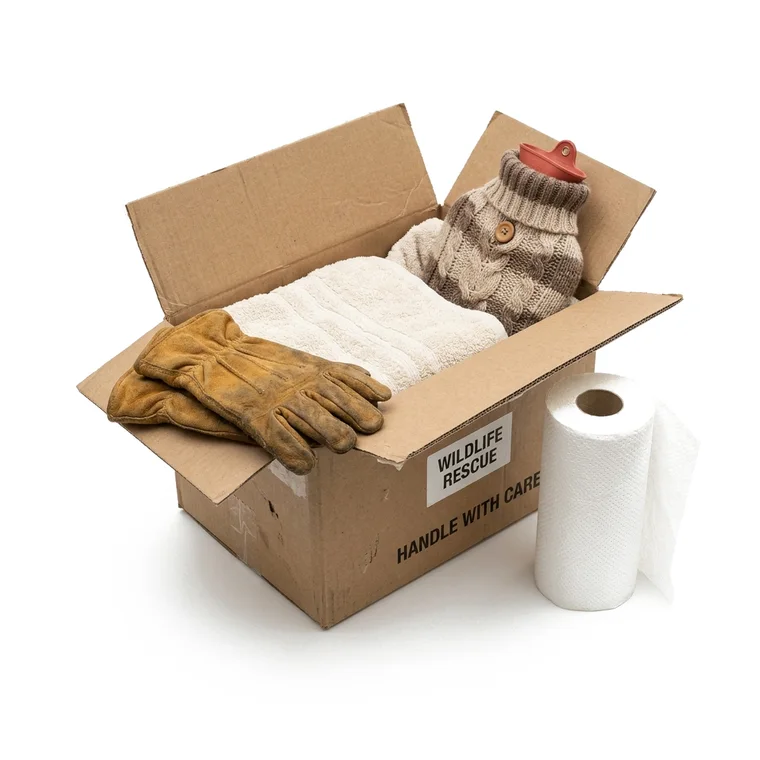
A cardboard box, an old towel, thick gloves, a pair of scissors, kitchen roll and a bottle you can fill with warm water. That is genuinely it.
What a rescue will ask
What it is, where you found it (exactly), what happened, how long ago, and what it is doing now. A photo helps enormously.
Vets will help
Under the RCVS code, vets are expected to provide emergency first aid and pain relief to wildlife. Most do not charge — ring ahead.
Prevention
Help them where you live
- Save your local rescue’s number in your phone today.
- Keep a “wildlife box” — box, towel, gloves — in the shed or car.
- Print the emergency card from our homepage for your fridge.
The law. In the UK you may take a sick or injured wild animal into temporary care in order to get it treated and released. Keeping it longer, or keeping protected species, is generally not allowed.
FAQ
Questions people ask
The nearest rescue says “full”. What now?
What if I cannot get it anywhere tonight?
Do I have to pay?
Ready to call?
Find a rescue near you
Ranked by who has confirmed space, then distance. Free, no sign-up.
General first-aid guidance compiled from UK rescue organisations, not veterinary advice. Where this and a vet disagree, the vet is right.